
Web Bloopers: 60 Common Web Design Mistakes, and How to Avoid Them by Jeff Johnson
English | ISBN: 1558608400 | 344 Pages | PDF | 79 Mb
The dot.com crash of 2000 was a wake-up call, and told us that the Web has far to go before achieving the acceptance predicted for it in '95. A large part of what is missing is quality; a primary component of the missing quality is usability. The Web is not nearly as easy to use as it needs to be for the average person to rely on it for everyday information, commerce, and entertainment.
In response to strong feedback from readers of GUI BLOOPERS calling for a book devoted exclusively to Web design bloopers, Jeff Johnson calls attention to the most frequently occurring and annoying design bloopers from real web sites he has worked on or researched. Not just a critique of these bloopers and their sites, this book shows how to correct or avoid the blooper and gives a detailed analysis of each design problem.
Hear Jeff Johnson's interview podcast on software and website usability at the University of Canterbury (25 min.)
* Discusses in detail 60 of the most common and critical web design mistakes, along with the solutions, challenges, and tradeoffs associated with them.
* Covers important subject areas such as: content, task-support, navigation, forms, searches, writing, link appearance, and graphic design and layout.
* Organized and formatted based on the results of its own usability test performed by web designers themselves.
with new and emerging web design no-no's (because new bloopers are born every day) along with a much requested printable blooper checklist for web designers and developers to use.


Hacking - The Art of Exploitation - Second Edition w/ LiveCD
Language: English
Publisher: No Starch Press; 2nd edition (January 11, 2008)
ISBN-10: 1593271441 | ISBN-13: 978-1593271442 | Format: PDF | 719 MB
Hacking is the art of creative problem solving, whether that means finding an unconventional solution to a difficult problem or exploiting holes in sloppy programming. Many people call themselves hackers, but few have the strong technical foundation needed to really push the envelope.
Rather than merely showing how to run existing exploits, author Jon Erickson explains how arcane hacking techniques actually work. To share the art and science of hacking in a way that is accessible to everyone, Hacking: The Art of Exploitation, 2nd Edition introduces the fundamentals of C programming from a hacker's perspective.
The included LiveCD provides a complete Linux programming and debugging environment-all without modifying your current operating system. Use it to follow along with the book's examples as you fill gaps in your knowledge and explore hacking techniques on your own. Get your hands dirty debugging code, overflowing buffers, hijacking network communications, bypassing protections, exploiting cryptographic weaknesses, and perhaps even inventing new exploits. This book will teach you how to:
- Program computers using C, assembly language, and shell scripts
- Corrupt system memory to run arbitrary code using buffer overflows and format strings
- Inspect processor registers and system memory with a debugger to gain a real understanding of what is happening
- Outsmart common security measures like nonexecutable stacks and intrusion detection systems
- Gain access to a remote server using port-binding or connect-back shellcode, and alter a server's logging behavior to hide your presence
- Redirect network traffic, conceal open ports, and hijack TCP connections
- Crack encrypted wireless traffic using the FMS attack, and speed up brute-force attacks using a password probability matrix
Hackers are always pushing the boundaries, investigating the unknown, and evolving their art. Even if you don't already know how to program, Hacking: The Art of Exploitation, 2nd Edition will give you a complete picture of programming, machine architecture, network communications, and existing hacking techniques. Combine this knowledge with the included Linux environment, and all you need is your own creativity.


Make a Flash Drive Bootable Without Any Software Easily
Generally we install Windows with DVDs or CDs but these disks need more care and may corrupt after sometime. To get rid from these CD’s and DVD’s. We can use Flash Drive instead of these compact disks.
This tutorial is quite complicated and lengthy but not too much.
To Make your flash drive boot-able just follow the following steps:
1. First of all, open Run (Win + R) then type in the text box “diskpart” and press OK
1. First of all, open Run (Win + R) then type in the text box “diskpart” and press OK

3. Then type the command “list disk”, then select your disk as my desired disk is disk 1. So, I type “select disk 1” (As shown below). You can check whether you select right disk you can type “detail disk” after selecting a disk. (As shown below)

4. After selecting your appropriate disk type the following commands one by one.
Clean
Create partition primary
Select partition 1
Active
Format fs=fat32
Clean
Create partition primary
Select partition 1
Active
Format fs=fat32
The last command that is “format fs=fat32” may take some time according to your flash drive size.

6. Then, copy the all files present in your DVD to the flash drive.

H: CD BOOT
BOOTSECT.EXE /NT60 I:
In above commands the H: is my DVD drive disk letter and I: is my flash drive disk letter.

8. Now you can boot your flash drive to install windows.
9. Just select your flash drive to first boot drive.By pressing F9, F10, F11, F12 keys simultaneously (May vary according to BIOS)


AMD Catalyst 13.3 Embedded Ver 12.101 | 986MB
The company AMD has released drivers for integrated graphics ATI \ AMD. This issue has become more optimized games.
Warning:
This driver package is designed exclusively for the integrated graphics card (list below). For all other GPU (desktop and mobile) latest drivers - 13.1 (or 13.2 beta 7)
Supported devices:
E6760
E6460
R-Series
G-Series
Radeon HD 6970M
Radeon HD 5770
System requirements:
Windows Vista | Windows 7 | Windows 8 (32 \ 64-bits)
Bitshare
http://adf.ly/Lvzfi
http://adf.ly/Lvzfj
http://adf.ly/Lvzfk
http://adf.ly/Lvzfl
http://adf.ly/Lvzfm
Uploaded.Net
http://adf.ly/Lvzfo
http://adf.ly/Lvzfp
http://adf.ly/Lvzfq
http://adf.ly/Lvzfr
http://adf.ly/Lvzfs
Rapidgator
http://adf.ly/Lvzft
http://adf.ly/Lvzfu
http://adf.ly/Lvzfv
http://adf.ly/Lvzfw
http://adf.ly/Lvzfx

Before start the tutorial we illustrate you to “How to Hide a File”.
The Simple Steps to hide a file is given below:
1. First take a file which you want to hide then Right click on the file and click on properties or just select the file and press the combination Alt + Enter. Then check the checkbox named “hidden” then click Ok
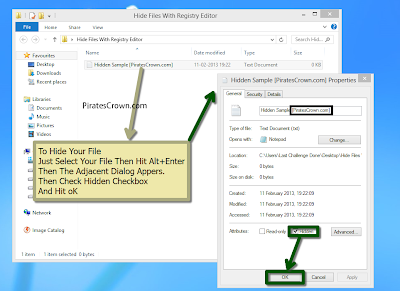
So, Now you successfully hidden the file.
How to Show it (the hidden file) with Registry Editor
1. First open run simply by pressing the combination Win+R, then write regedit in text field and press OK.

2. Now Registry Editor is appear to you, then follow the path Computer/HKEY_CURRENT_USER/Software/Microsoft/Windows/CurrentVersion/Explorer/Advanced
and search for “Hidden” string.
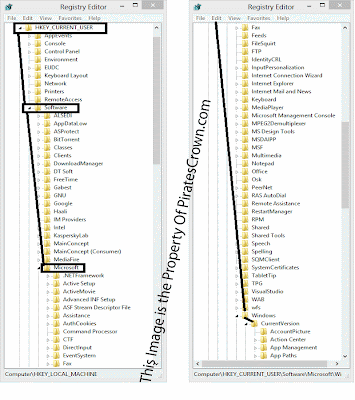
3. Double Click on Hidden String and change the value data to 1 to 2 for show the hidden file.

4. And if you want to hide the hidden files just change the hidden string value date from 2 to 1 and hit OK.

Note: All the Images Is High Quality, to get full high quality experience just save the image or one image in new tab or window.

Fool Your Friends With Intel® Core™ i11 Processor
Make fool your friends and classmates that you are using most expensive and fast processor. This post would show “How can you change your processor name” by changing the registry and fool your friends into believing that you have the latest version of processor which is yet to be launched. All the pictures given below is in High Definition Quality save them and get HQ quality.
So follow the simple steps given below:-
* First open run by using Win+R combination.
* Type “Regedit.exe” (without qoutes) and press OK.

* After Pressing OK, Registry Editor is open and expand the tree in following order.

* Computer/HKEY_LOCAL_MACHINE/HARDWARE/DESCRIPTION/System/CentralProcessor/0
* In 0 folder “ProcessorNameString” String there is my default processor name “Intel® Core™ i5” .
* Now Double Click On “ProcessorNameString” String and change the value data accordingly
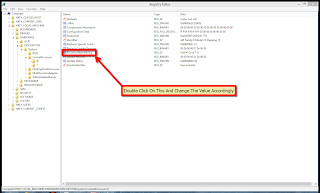


* Now you will see in Processor field the name of desired processor is shown.
* Note: This trick is one time trick that means the changes made are temporary and restore after a restart. So FOOL tHEM CaRefulLy.
* In 0 folder “ProcessorNameString” String there is my default processor name “Intel® Core™ i5” .
* Now Double Click On “ProcessorNameString” String and change the value data accordingly

* My default processor name “Intel® Core™ i5”
Processor and I want
to change it to “Intel® Core™ i11” . So, I change the value data to
“Intel® Core™ i11”
And Hit OK

* Now Check your computer properties, By Right clicking on Computer icon and
select properties.

* Note: This trick is one time trick that means the changes made are temporary and restore after a restart. So FOOL tHEM CaRefulLy.


